The New Urban Crisis by Richard Florida
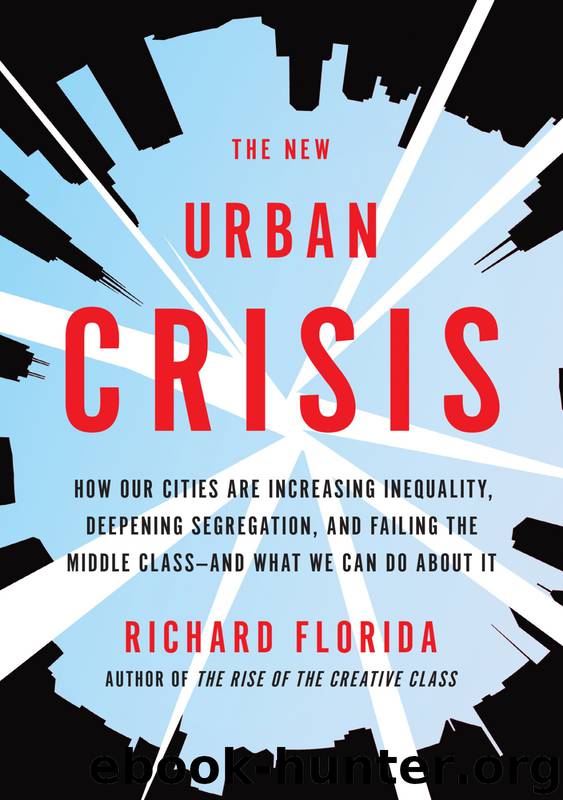
Author:Richard Florida [FLORIDA, RICHARD]
Language: eng
Format: epub
Publisher: Basic Books
Published: 2017-11-04T00:00:00+00:00
The suburban dimension of the New Urban Crisis not only affects those who live there but has broader costs that extend to the US economy as a whole. As well as being energy-inefficient and wasteful, suburban sprawl also limits the mobility of Americans and undermines productivity.
A suburban home was once a cornerstone of the American Dream; now, suburban sprawl has become a key factor holding back Americans’ ability to move up the economic ladder. The old saying “drive ’til you qualify” reflects the reality that real estate becomes more affordable in the farthest-out suburbs, but distance levies additional high costs. The rule of thumb is that people should spend roughly 30 percent of their income for housing, but up to 45 percent including transportation. Having multiple cars and keeping them insured, repaired, and fueled up on gas can be an expensive proposition. Living closer to where one works or being able to take public transit can slash those costs considerably. For this reason, a pricier condo or apartment in the urban core or along transit lines can end up being considerably more affordable than a cheaper house in a car-dependent suburb.
Instead of pushing people toward the American Dream, suburbia today actually hinders upward economic mobility. Economic mobility is significantly lower in more spread-out metros today than it is in denser cities. Lower-income workers in suburbia are farther removed from centers of work and have a harder time finding and getting to jobs than workers who are able to live in a city. The amount of time that low-income people spend commuting also plays a substantial role in affecting their odds of moving up the economic ladder, with low-income people with longer commutes facing lower levels of upward mobility. While it remains true that persistently poor urban neighborhoods concentrate and perpetuate a cycle of poverty, poor suburban neighborhoods also present challenges: they isolate and disconnect their residents both from jobs and from economic opportunity, and also from the social services that can mitigate poverty’s worst effects. Even when suburbs have social services, the poor are less able to access them because they are harder to find and harder to reach than urban social services.13
Suburban sprawl is extremely costly to the economy broadly. Infrastructure and vital local services—such as water and energy—can be 2.5 times more expensive to deliver in the suburbs than in compact urban centers. A UCLA study found that residents of wealthy Malibu, California (which has an average density of about 630 people per square mile), use more than ten times as much energy per person than residents of the working-class suburb of Bell, which has a density of about 14,000 per square mile. In total, sprawl costs the US economy roughly $600 billion a year in direct costs related to inefficient land usage and car dependency, and another $400 billion in indirect costs from traffic congestion, pollution, and the like, according to a 2015 study from the London School of Economics. The total bill: a whopping $1 trillion a year.
Download
This site does not store any files on its server. We only index and link to content provided by other sites. Please contact the content providers to delete copyright contents if any and email us, we'll remove relevant links or contents immediately.
| Anthropology | Archaeology |
| Philosophy | Politics & Government |
| Social Sciences | Sociology |
| Women's Studies |
Nudge - Improving Decisions about Health, Wealth, and Happiness by Thaler Sunstein(7707)
The Fire Next Time by James Baldwin(5446)
iGen by Jean M. Twenge(5416)
Adulting by Kelly Williams Brown(4574)
The Sports Rules Book by Human Kinetics(4388)
The Hacking of the American Mind by Robert H. Lustig(4383)
The Ethical Slut by Janet W. Hardy(4253)
Captivate by Vanessa Van Edwards(3840)
Mummy Knew by Lisa James(3693)
In a Sunburned Country by Bill Bryson(3542)
The Worm at the Core by Sheldon Solomon(3487)
Ants Among Elephants by Sujatha Gidla(3467)
The 48 laws of power by Robert Greene & Joost Elffers(3291)
Suicide: A Study in Sociology by Emile Durkheim(3023)
The Slow Fix: Solve Problems, Work Smarter, and Live Better In a World Addicted to Speed by Carl Honore(3009)
The Tipping Point by Malcolm Gladwell(2925)
Humans of New York by Brandon Stanton(2873)
Get What's Yours for Medicare: Maximize Your Coverage, Minimize Your Costs by Philip Moeller(2736)
Handbook of Forensic Sociology and Psychology by Stephen J. Morewitz & Mark L. Goldstein(2705)
